
Search has changed more in the last two years than in the previous decade. People no longer just type keywords into a search box — they ask questions inside ChatGPT, Google’s AI Overviews, Perplexity, and voice assistants, expecting a direct answer, not a list of ten blue links. If your business isn’t visible inside these AI-driven answers, you’re invisible to a growing share of your potential customers.
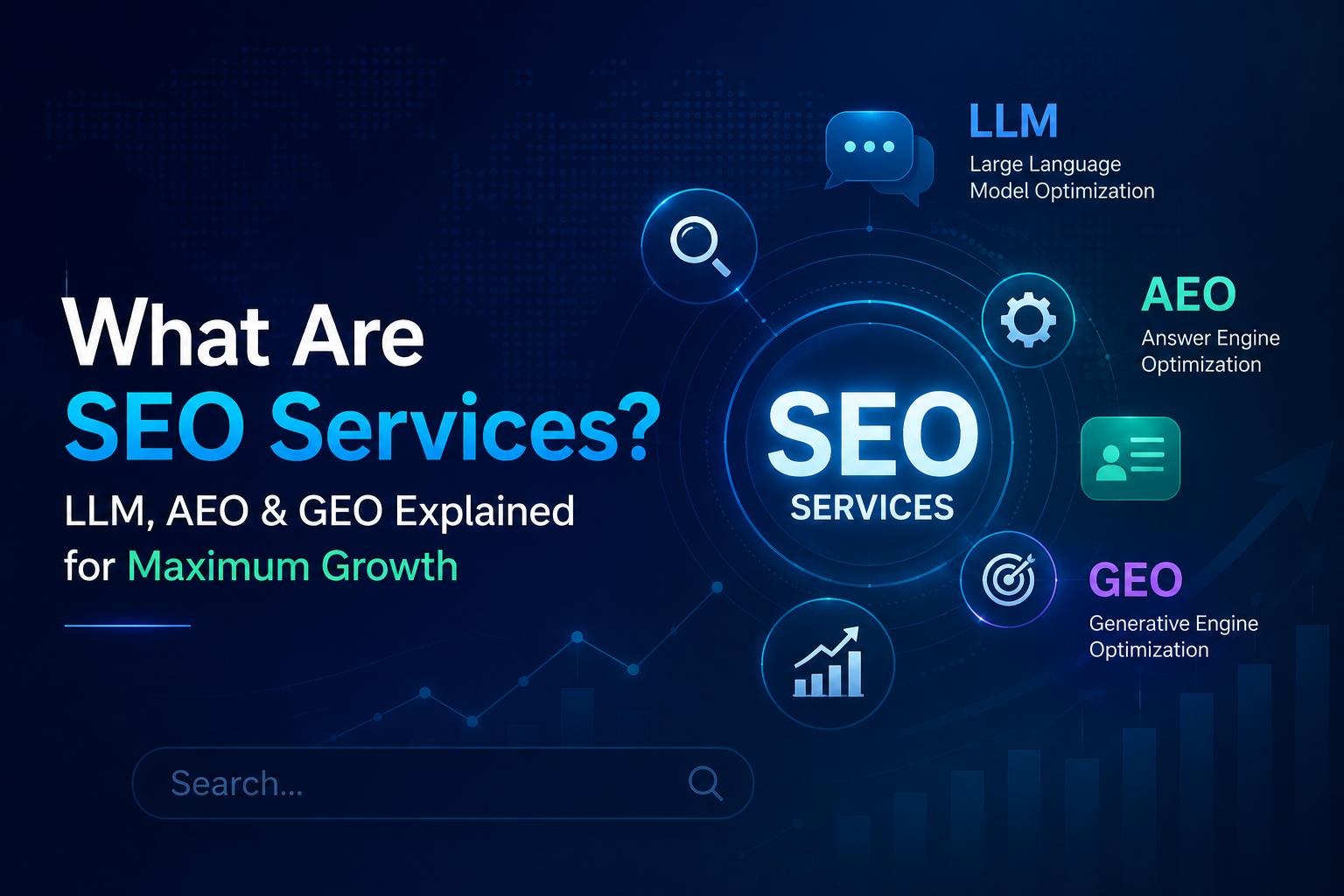
That’s exactly why CompactInfo built an SEO service model around three connected disciplines: traditional SEO, AEO (Answer Engine Optimization), and GEO (Generative Engine Optimization) — all powered by LLM-aware keyword targeting. This isn’t a rebrand of old-school SEO. It’s a complete strategy designed to make your website rank in Google, get cited inside AI-generated answers, and show up when someone asks an AI assistant “who’s the best [your service] near me?”
If you’re still wondering what is SEO and why it now includes AI answer engines, this guide walks through every service, strategy, and industry we work with — in plain language, with no fluff.
Consider how differently people search today compared to five years ago. A homeowner looking for a contractor might still type “roofing company near me” into Google — but they might also ask an AI assistant, “which roofing companies in my area have the best reviews and offer financing?” and expect a synthesized, specific answer with names attached. If your business isn’t structured, described, and reinforced across the web in a way that AI systems can confidently pull from, you simply won’t be in that answer, no matter how good your service actually is.
This is the gap CompactInfo was built to close. We don’t treat AI search as a future trend to plan for later — it’s already reshaping click-through rates on traditional search results, and businesses that adapt now are the ones capturing that traffic before it becomes standard practice for every agency to chase.
Why SEO, AEO & GEO Together — Not Separately
Traditional SEO gets your pages to rank on Google’s search results page. AEO makes your content the kind of clear, structured answer that voice assistants and featured snippets pull directly. GEO goes one step further — it optimizes your brand’s presence so that large language models like ChatGPT, Gemini, and Claude actually reference and recommend your business when users ask open-ended questions.
Treating these as separate projects wastes time and budget. CompactInfo builds one unified content and technical foundation that satisfies all three at once: structured data that search engines and LLMs can parse, content written to directly answer real questions, and authority signals (reviews, citations, backlinks) that both Google’s algorithm and AI models trust. Understanding why SEO is important for any website is the first step — understanding how AI has changed the rules is what keeps you ahead of competitors who are still doing SEO the old way.
Smart Keyword Targeting with LLM, AEO & GEO
Keyword research used to mean stuffing a page with exact-match phrases. That approach is dead. Modern keyword targeting has to account for how large language models understand intent, context, and conversational phrasing.
Our smart keyword targeting process combines:
- Semantic keyword clustering — grouping related search terms and conversational queries around a single topic, so one page can rank for dozens of variations instead of just one exact phrase.
- Question-based keyword mapping — identifying the actual questions people ask AI assistants and structuring content to answer them directly, in the first two sentences.
- Entity and topic modeling — helping search engines and LLMs understand what your business is, not just what words appear on your page.
- Prompt-pattern research — studying how people phrase requests inside AI chat tools, then building content around those natural-language patterns rather than robotic keyword strings.
This is what separates a page that merely contains a keyword from a page an AI model actually trusts enough to cite as a source.
Local SEO
If your business serves a specific city, region, or neighborhood, local SEO is where most of your revenue opportunity lives. We optimize Google Business Profiles, build consistent NAP (Name, Address, Phone) citations across directories, manage local reviews, and create location-specific landing pages that rank for “near me” and city-based searches.
We also work with businesses on tighter budgets. Our affordable local SEO packages under $100 give small businesses a realistic entry point into local search visibility without the enterprise-agency price tag. And if you’re specifically looking at regional pricing, our SEO packages and pricing in Florida breakdown shows exactly what’s included at each tier.
Local SEO today also means optimizing for voice queries (“find a plumber open now near me”) and for AI assistants that pull local business recommendations directly from structured data — another place where our AEO and GEO work pays off.
A strong local SEO foundation typically includes:
- Complete, keyword-optimized Google Business Profile setup and ongoing management
- Location-specific landing pages for businesses serving multiple cities or service areas
- Local citation building and cleanup across data aggregators and industry directories
- Localized schema markup (LocalBusiness, service area, opening hours, aggregate ratings)
- Review generation campaigns and reputation monitoring
- Local link building through community partnerships, sponsorships, and local press
For businesses just starting out, local SEO is usually the fastest path to measurable results, because competition is narrower and intent is higher — someone searching “emergency electrician near me” is typically ready to hire within hours, not weeks.
Customized SEO Strategies
No two businesses compete in the same market, target the same audience, or start from the same technical baseline. That’s why we don’t sell templated packages disguised as “custom strategy.” Every engagement starts with a full audit of your current site, your competitors, your industry, and your growth goals — then we build a roadmap around what will actually move revenue for your specific business, whether that’s e-commerce transactions, lead form submissions, phone calls, or foot traffic.
AI-Powered SEO
AI isn’t just changing how users search — it’s changing how SEO itself gets done. We use AI tools for content gap analysis, predictive keyword trend spotting, automated technical audits, and content optimization scoring, layered with human strategy and editorial judgment so nothing feels robotic or generic.
If you want to understand the mechanics in more depth, our breakdown of artificial intelligence benefits for SEO explains exactly how machine learning models influence rankings today and what that means for your content strategy going forward.
Reputation Management
Rankings mean little if searchers see a page full of negative reviews once they click through. We monitor brand mentions across Google, Yelp, industry-specific review platforms, and social channels, respond to reviews professionally, and build a proactive review-generation system so positive, recent feedback consistently outweighs the occasional bad experience. Reputation signals also directly influence how AI models describe your brand when asked for recommendations — another reason this work now sits inside the SEO umbrella rather than off to the side.
Reputation management works best as an ongoing habit rather than a reaction to a crisis. We set up automated, compliant review request systems triggered at the right moment in the customer journey, track sentiment trends over time so small issues get caught before they become patterns, and make sure every negative review receives a thoughtful, public response — because how a business handles criticism is often just as persuasive to a prospective customer as the review itself.
E-commerce SEO
Online stores face a unique set of challenges: thousands of product pages, duplicate content risks, faceted navigation issues, and constant inventory changes. Our e-commerce SEO service covers product page optimization, category structure planning, schema markup for rich results (star ratings, price, stock status), site speed improvements for high page-count stores, and internal linking strategies that push authority toward your best-converting products.
We also address the problems that are unique to online retail at scale: what happens to a product page’s SEO value when an item goes out of stock, how to structure filtered and faceted category pages so search engines don’t waste crawl budget on thousands of near-duplicate URL variations, and how to write product descriptions that are unique enough to rank instead of duplicating manufacturer copy used across dozens of competing stores. For seasonal or high-SKU catalogs, we also build programmatic templates that keep new product pages SEO-ready from the moment they go live, without requiring manual optimization for every single listing.
Technical SEO
Technical SEO is the foundation everything else sits on. If Google can’t crawl, render, and index your site efficiently, none of your content or backlink work matters. Our technical SEO audits cover:
- Site speed and Core Web Vitals
- Mobile usability and responsive design
- Crawl budget and indexation issues
- XML sitemaps and robots.txt configuration
- Structured data (schema.org markup)
- HTTPS, canonicalization, and duplicate content resolution
- JavaScript rendering issues for modern web frameworks
Each of these might sound like a small technical detail, but they compound. A site with slow load times loses visitors before they even see your content. A site with unresolved duplicate content confuses search engines about which page to rank, splitting authority that should be concentrated on one strong page. A missing or broken sitemap can leave entire sections of a site un-crawled for months without anyone noticing. Technical SEO is unglamorous work, but it’s often the difference between a content strategy that succeeds and one that quietly underperforms for reasons no one can diagnose.
Content Marketing
Content is what fuels every part of this strategy — rankings, authority, backlinks, and AI citations all trace back to genuinely useful content. We build content calendars around real search demand, produce long-form guides, blog posts, comparison pages, and landing pages, and structure everything to satisfy both human readers and answer engines. For a deeper look at how content and SEO reinforce each other, see our guide on content marketing and SEO.
Good content marketing isn’t about publishing more — it’s about publishing the right pieces at the right depth. A single well-researched, thoroughly structured guide that answers every question a buyer has will consistently outperform ten shallow, generic blog posts. We map content to each stage of the buying journey: awareness content that answers broad questions, consideration content that compares options, and decision content that pushes a ready buyer toward a call, form, or purchase. Every piece is also built with internal linking in mind, so authority flows naturally between related pages instead of being trapped in isolated posts no one else on the site links to.
Off-Page Optimization
Off-page SEO builds the authority signals that happen outside your own website — backlinks from relevant, trustworthy sites, brand mentions, guest content, digital PR, and social proof. We prioritize quality and relevance over volume; a handful of links from respected industry sites will outperform hundreds of low-quality directory links every time.
On-Page Optimization
On-page work covers everything within your direct control: title tags, meta descriptions, header hierarchy, internal linking, image alt text, URL structure, and content optimization around your target keyword clusters. Done well, on-page SEO makes it effortless for both search engines and AI crawlers to understand exactly what a page is about and who it’s for.
Keyword Research and Analysis
Every strategy starts with research, not guesswork. We analyze search volume, keyword difficulty, commercial intent, seasonal trends, and — increasingly — the conversational, question-based phrasing used in AI chat tools. The output isn’t a spreadsheet you never look at again; it’s a prioritized roadmap tied directly to the pages we’ll build or optimize first.
In-Depth SEO Website Audit
Before we recommend anything, we audit. Our audits examine technical health, content quality, backlink profile, competitor positioning, and user experience, then translate findings into a prioritized action plan ranked by impact and effort — so you know exactly what to fix first and why.
Analyzing Your Products and Services
We start by understanding what you actually sell and to whom, mapping each product or service line to its own search demand so nothing valuable gets buried or left without a dedicated landing page.
Mapping Your Requirements to Your Website Structure
Business goals only translate into rankings if your site architecture supports them. We map your priority services and products to a logical URL and navigation structure, so search engines can clearly understand site hierarchy and users can find what they need in a click or two.
Conducting In-Depth Competitor Analysis
We study who’s currently ranking above you — their content structure, backlink sources, keyword targeting, and technical setup — to identify realistic opportunities to outrank them, not just copy them.
Generating Research-Based Keywords for Your Website Ranking
Using real search data rather than assumptions, we generate a keyword list grounded in actual demand, competitive feasibility, and business value, prioritized by what will drive qualified traffic fastest.
In-Depth Analysis of Target Audience
Understanding who searches for your business — their intent, stage in the buying journey, and the language they naturally use — shapes everything from keyword selection to content tone and page structure.
Link Building
Backlinks remain one of the strongest ranking signals in search. Our link building approach focuses on earning links through digital PR, guest contributions, resource page outreach, and genuinely link-worthy content — never through spammy link farms or paid link schemes that put your site at risk of penalties.
A single link from a well-known, relevant publication in your industry can carry more weight than a hundred links from low-quality, unrelated directories — and it carries far less risk. We also look at link building as a brand-building exercise, not just a ranking tactic: the same digital PR outreach that earns a backlink often earns brand mentions, referral traffic, and social proof that compound in value well beyond the immediate SEO benefit. Every link we pursue is evaluated for relevance, domain trust, and the likelihood it will actually send real traffic — not just move a metric.
Content Creation and Syncing
We don’t just write content in isolation — we sync it across your website, blog, and Google Business Profile so messaging stays consistent everywhere a potential customer might encounter your brand. This includes syncing service updates, new locations, and offers so your SEO content never falls out of date.
Implementing Advanced AI-Based SEO Techniques
Beyond basic AI-assisted writing, we implement advanced techniques including AI-driven content scoring against top-ranking competitors, automated internal linking suggestions based on topical relevance, predictive search trend modeling, and structured data generation optimized for AI answer extraction.
Web Development Capabilities
SEO and web development can’t be separated — a beautifully optimized content strategy still fails on a slow, poorly coded website. Our development team builds and improves sites for speed, mobile responsiveness, and conversion, and handles specialized builds for industries with unique needs.
For example, our real estate web development services include IDX/MLS integration and property search functionality built with SEO in mind from day one, and our packers and movers web development services are built specifically for logistics and relocation businesses that need quote forms, service-area pages, and local SEO working together.
If you’re still running on an outdated site, it’s worth reading how a website can take your business to the next level — the difference in lead quality and volume is often dramatic. And every strategy we build fits inside a broader digital marketing strategy, so SEO never operates in a silo away from your paid, social, and email efforts.
Monitoring and Reporting
SEO isn’t a set-it-and-forget-it service. We track rankings, organic traffic, conversions, backlink growth, and technical health on an ongoing basis, and deliver reports that focus on business outcomes — leads, calls, and revenue — not just vanity metrics like keyword position alone.
Competitor Analysis
Markets shift constantly. We continuously monitor what competitors are publishing, which keywords they’re gaining or losing, and where new backlink opportunities appear, so your strategy adapts before a competitor pulls ahead rather than after.
This isn’t a one-time report we hand over at the start of an engagement — competitor visibility is tracked on an ongoing basis alongside your own site, so if a competitor suddenly ranks for a valuable new keyword cluster or earns a wave of backlinks from a PR campaign, we know about it quickly and can decide whether and how to respond, rather than discovering the shift months later in a quarterly review.
Algorithm Updates and Adaptation
Google rolls out core updates multiple times a year, and AI search engines evolve even faster. We monitor algorithm changes closely, diagnose any ranking or traffic impact quickly, and adjust strategy — rather than reacting months later once the damage compounds.
We separate genuine algorithm-driven ranking changes from other causes, like a technical issue or a strong competitor content push, since the fix for each is completely different. Chasing the wrong cause wastes time and can lead to changes that hurt more than they help.
Voice Search Optimization
Voice queries tend to be longer, more conversational, and question-based than typed searches. We optimize for voice by structuring content around natural-language questions, using concise direct-answer formatting near the top of relevant pages, and ensuring local business data is accurate and complete — since a huge share of voice searches are local (“call a locksmith near me”).
Penalty Assessment and Recovery
If your site has been hit by a manual action or lost visibility after an algorithm update, we conduct a full forensic audit to identify the cause — whether it’s a toxic backlink profile, thin or duplicate content, or a technical issue — and build a recovery plan to restore rankings and prevent recurrence.
On-Page SEO, Off-Page SEO & Technical SEO — Working Together
These three pillars are often sold as separate services, but they only produce real results when they work in sync. A technically flawless site with no content strategy won’t rank. Great content on a slow, poorly structured site won’t rank either. Our approach treats on-page, off-page, and technical SEO as one integrated system, not three disconnected checklists.
Local SEO & International SEO
Whether your business serves one neighborhood or a dozen countries, geographic targeting needs its own strategy. For multi-location or global businesses, our international SEO services cover hreflang implementation, country-specific content, currency and language localization, and region-specific keyword research — so you rank correctly in every market you serve, not just your home country.
Content Creation and Optimization
Beyond blog posts, this covers landing pages, service pages, FAQ pages, and comparison content — all optimized for both search rankings and AI answer extraction, written to sound like a knowledgeable human, not a keyword-stuffed template.
Advanced SEO
For established sites competing in crowded markets, advanced SEO includes topic cluster architecture, log file analysis, JavaScript SEO for single-page applications, programmatic SEO for large-scale page generation, and E-E-A-T (Experience, Expertise, Authoritativeness, Trustworthiness) signal building — the deeper technical and authority work that moves the needle once the basics are already in place.
Our SEO Process, Step by Step
Every engagement follows a consistent, transparent process rather than a black-box approach:
- Discovery call — we learn about your business, goals, budget, and current challenges.
- Full audit — technical, content, backlink, and competitor analysis to establish a clear baseline.
- Strategy roadmap — a prioritized plan tied to specific pages, keywords, and timelines, not vague promises.
- Execution — on-page, technical, content, and off-page work carried out in the order that produces the fastest meaningful impact.
- Monitoring and reporting — regular check-ins with real metrics, not just ranking screenshots.
- Iteration — strategy adjusts as data comes in, algorithms shift, and your business evolves.
This structure means you always know what’s being worked on, why it matters, and what to expect next — no guessing, no vague monthly updates that don’t tie back to business results.
Industries We Serve
SEO strategy has to reflect the realities of your specific industry — the buying cycle, the regulations, the competition, and the way customers actually search. CompactInfo builds tailored strategies across a wide range of sectors, including:
- E-commerce — product and category page optimization, shopping feed SEO, conversion-focused content
- Healthcare — compliant, trust-focused content, local provider SEO, appointment-driven landing pages
- Real Estate — property search optimization, agent and brokerage local SEO, MLS-integrated web development
- Education — program and course page SEO, enrollment-focused content strategy
- Finance & Banking — E-E-A-T-heavy content, compliance-aware copy, high-trust authority building
- Travel & Tourism — destination and itinerary content, seasonal keyword targeting
- Hospitality (Hotels & Restaurants) — local SEO, booking-focused landing pages, review management
- IT & Software — technical content, comparison pages, developer-focused keyword targeting
- SaaS (Software as a Service) — feature and use-case pages, free-trial funnel SEO, competitor comparison content
- Legal Services — practice-area pages, local SEO for law firms, compliance-conscious content
- Automotive — dealership local SEO, inventory-based landing pages, service-area targeting
- Fitness & Wellness — class and membership landing pages, local SEO, community content
- Fashion & Apparel — e-commerce SEO, seasonal collection content, visual search optimization
- Beauty & Cosmetics — product SEO, influencer and review integration, local salon/spa SEO
- Food & Beverage — menu and location SEO, delivery platform integration, local search visibility
- Construction & Home Services — service-area pages, quote-driven landing pages, local SEO
- Entertainment & Media — content hub SEO, high-volume publishing strategy, trending topic targeting
- Gaming — community-focused content, release and update SEO, review and forum visibility
- Non-Profit Organizations — donation and awareness-focused content, local and cause-based SEO
- Local Businesses — Google Business Profile optimization, citation building, review generation
- Pet Care — service-area SEO, appointment-booking landing pages, local visibility for clinics and groomers
Whatever your industry, the underlying goal is the same: connect the right searchers with your business at the exact moment they’re ready to act.
Why Choose Our SEO Services?
There’s no shortage of agencies claiming to be SEO experts. Here’s what actually separates CompactInfo:
- We plan for AI search, not just Google. LLM, AEO, and GEO strategy is built into every engagement, not sold as an expensive add-on.
- Custom strategy, not templates. Every plan starts with a real audit of your site, competitors, and industry.
- Transparent reporting. You’ll always know what’s being done and why, tied to business outcomes, not vanity metrics.
- In-house web development. SEO and development working together means faster fixes and better-performing sites.
- Flexible pricing. From affordable local SEO packages under $100 for small businesses to advanced enterprise strategies, we scale to your budget and goals.
- No spam tactics. No link farms, no keyword stuffing, no shortcuts that put your site at risk of penalties.
- Proven process. Every step — audit, research, on-page and off-page execution, content, monitoring — follows a documented, repeatable methodology.
- We speak plain English. Reports and strategy calls explain what’s happening and why it matters to your business, not just jargon and dashboards.
- Long-term partnership mindset. We aim to be the SEO team you keep for years, not the agency you fire after six confusing months.
Choosing an SEO partner is ultimately a bet on who will still be delivering results a year from now, after the algorithm has changed several more times and competitors have hired their own agencies. CompactInfo’s model — grounded in real audits, adaptable strategy, and AI-era readiness — is built for exactly that kind of durability.
Frequently Asked Questions
1. What’s the difference between SEO, AEO, and GEO? SEO focuses on ranking in traditional search engine results. AEO (Answer Engine Optimization) focuses on getting your content pulled into direct answers, featured snippets, and voice search results. GEO (Generative Engine Optimization) focuses on getting your brand cited and recommended inside AI-generated responses from tools like ChatGPT and Google AI Overviews. We build all three into a single strategy.
2. How long does it take to see SEO results? Most businesses start seeing measurable movement in rankings and traffic within three to four months, with significant results typically compounding over six to twelve months. Timelines vary based on competition, site history, and starting point.
3. Do you offer month-to-month SEO plans, or only long-term contracts? We offer flexible engagement options, including entry-level and month-to-month plans, so businesses of any size can get started without a long-term commitment.
4. Is local SEO different from regular SEO? Yes. Local SEO focuses specifically on ranking for geographically targeted searches — think Google Business Profile optimization, local citations, and “near me” queries — while general SEO targets broader, non-location-specific search intent.
5. Can you help recover a site that lost rankings after a Google update? Yes. Our penalty assessment and recovery process identifies the root cause of the drop — whether algorithmic, technical, or link-related — and builds a targeted plan to restore visibility.
6. Do you write the content, or do we need to provide it? We handle content creation end-to-end — research, writing, on-page optimization, and publishing — though we’re also happy to optimize and restructure existing content if you prefer to keep your current writers.
7. How do you optimize for AI tools like ChatGPT and Google AI Overviews? Through structured, direct-answer content formatting, strong topical authority, clean structured data, and consistent, trustworthy brand signals across the web — all of which influence whether AI models cite and recommend your business.
8. What industries do you specialize in? We work across e-commerce, healthcare, real estate, legal, SaaS, hospitality, finance, and many more — tailoring strategy to each industry’s specific buying behavior and competitive landscape.
9. What’s included in an SEO website audit? A full audit covers technical health (speed, crawlability, indexation), on-page factors (titles, headers, content quality), backlink profile analysis, competitor benchmarking, and a review of your current keyword rankings — delivered with a prioritized action plan, not just a list of problems.
10. Do you work with businesses outside the United States? Yes. Through our international SEO services, we support businesses targeting multiple countries and languages, with localized keyword research, hreflang setup, and region-specific content strategy.
Final Thoughts
SEO in 2026 is no longer just about ranking on page one of Google — it’s about being the answer AI tools give, the business a voice assistant recommends, and the brand customers trust across every surface where they search. CompactInfo builds strategies around all of it: technical SEO, on-page and off-page optimization, local and international targeting, AI-powered research, and content built to perform in both traditional and generative search.
If you’re ready to build a strategy that works across Google, voice search, and AI answer engines alike, CompactInfo’s team is ready to start with a full audit of where you stand today.
