
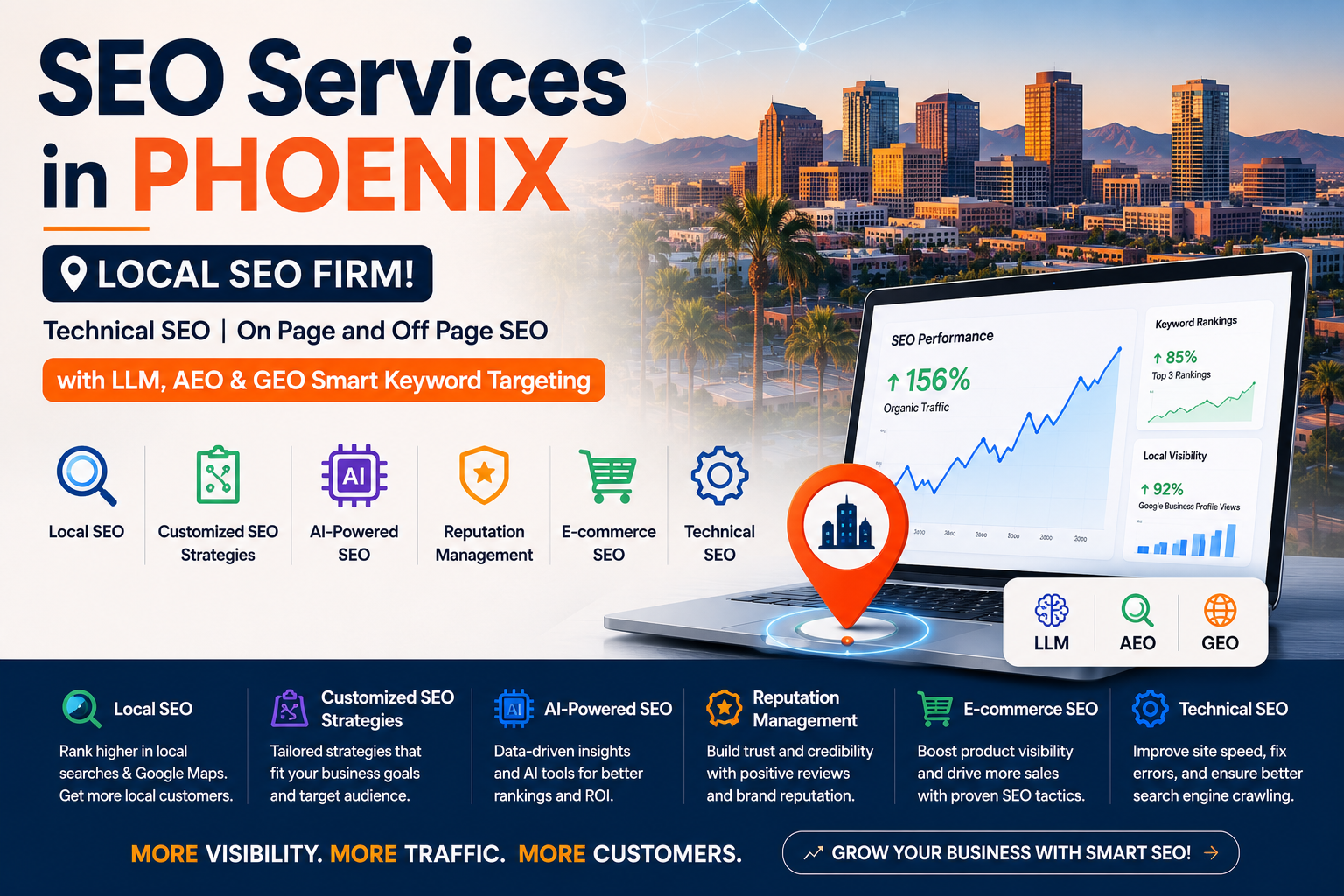
Phoenix is one of the fastest-growing metropolitan areas in the country, and with that growth comes fierce competition for online visibility. Whether you run a local home services company in Mesa, an e-commerce brand shipping out of Tempe, a medical practice in Scottsdale, or a professional services firm in downtown Phoenix, the same reality applies: if customers can’t find you in search, they will find your competitor instead.
For years, “SEO” meant chasing a handful of blue links on a Google results page. That world no longer exists. Search has fragmented into traditional organic results, local map packs, voice assistants, and a fast-growing layer of AI-generated answers from tools like ChatGPT, Google’s AI Overviews, Perplexity, and Copilot. A business that only optimizes for the old rules is already falling behind.
This guide walks through what a modern, comprehensive SEO strategy looks like for a Phoenix-based business — one that blends time-tested technical and on-page fundamentals with newer disciplines like Answer Engine Optimization (AEO) and Generative Engine Optimization (GEO). Each section below reflects a real service area that should be part of any serious SEO engagement.
Why Phoenix Businesses Need a Different Kind of SEO Partner
Phoenix isn’t a generic market. It’s a sprawling metro with distinct submarkets — Scottsdale, Chandler, Glendale, Tempe, Gilbert, Peoria — each with its own competitive dynamics and customer expectations. A national SEO vendor working from a template will rarely understand the nuance of why a roofing company in Surprise competes differently than one in Ahwatukee, or why search intent for “best Italian restaurant” shifts depending on which Phoenix neighborhood someone is searching from.
A local SEO firm brings several advantages that out-of-state or fully automated agencies struggle to replicate:
- Familiarity with the Phoenix business landscape, seasonal trends (think snowbird season, monsoon season service spikes, and summer HVAC demand), and local search behavior.
- The ability to build genuinely local backlinks and citations from Arizona-based directories, news outlets, and business associations.
- An understanding of how Phoenix’s competitive density in industries like real estate, home services, healthcare, and legal services affects keyword difficulty and content strategy.
- Direct, responsive communication without the layers of account management common at larger national agencies.
With that context established, let’s go through the core service pillars that make up a complete SEO program.
Local SEO
Local SEO is the practice of optimizing your online presence so that nearby customers find you when they search for the products or services you offer. For a huge share of Phoenix businesses — contractors, dentists, restaurants, auto shops, salons, attorneys — local search is the single highest-converting channel available, because the person searching is often ready to buy or book immediately.
A thorough local SEO program typically includes:
Google Business Profile optimization. This means filling out every available field accurately, selecting the correct primary and secondary categories, uploading high-quality photos regularly, and keeping hours, services, and attributes current. An incomplete or stagnant profile signals low relevance to Google’s local algorithm.
Citation building and consistency. Your business name, address, and phone number (commonly called NAP) need to match exactly across every directory, from major platforms like Yelp and the Better Business Bureau to Phoenix-specific chambers of commerce and industry associations. Inconsistent listings confuse both search engines and customers.
Review generation and management. Reviews are one of the strongest local ranking signals and one of the most persuasive trust factors for customers. A structured system for requesting reviews after a positive customer interaction, combined with thoughtful responses to both positive and negative feedback, compounds over time into a powerful reputation asset.
Local landing pages. Businesses that serve multiple Phoenix-area cities benefit from dedicated, genuinely useful location pages rather than thin, duplicated templates. Each page should speak to the specific neighborhood, mention local landmarks or service areas, and avoid being a copy-paste of the page next to it.
Map pack optimization. The three-pack of local results that appears above organic listings for many searches is driven by a combination of relevance, distance, and prominence. Local SEO work directly targets all three factors.
Customized SEO Strategies
There is no universal SEO playbook that works equally well for a law firm, a dental practice, and an online retailer. A customized strategy starts with a discovery process that examines your business model, your sales cycle, your existing digital footprint, and your realistic growth targets.
This process typically involves:
- Reviewing historical analytics and search console data to understand what’s currently working and what isn’t.
- Identifying which channels (organic search, local search, paid, AI search) offer the highest return given your industry and budget.
- Setting milestone-based goals rather than vague promises, so progress can be measured in concrete terms like ranking improvements, traffic growth, and lead volume.
- Building a prioritized roadmap that tackles the highest-impact issues first rather than a scattershot list of tasks.
A custom strategy is a living document. It should be revisited quarterly as algorithms shift, competitors react, and your business evolves — not a static plan written once and forgotten.
AI-Powered SEO
Search engines have become deeply reliant on machine learning to interpret content quality, user intent, and relevance. Google’s core ranking systems, including components related to helpful content and search quality, increasingly evaluate pages the way a sophisticated reader would, rather than simply counting keyword occurrences.
AI-powered SEO means using these realities to your advantage rather than fighting against them. In practice, this includes:
- Using AI-assisted tools to identify content gaps and topic clusters that competitors haven’t fully covered.
- Structuring content so that its key facts, definitions, and conclusions are easy for both human readers and machine systems to extract.
- Monitoring how algorithm updates affect rankings and adjusting content and technical elements accordingly, rather than reacting only after traffic has already dropped.
- Using natural language processing insights to ensure content actually answers the underlying question a searcher has, not just the literal keyword they typed.
AI-powered SEO isn’t about replacing strategic thinking with automation — it’s about using modern tools to execute strategy faster and with better data.
Reputation Management
Your search rankings and your reputation are more connected than most business owners realize. Review signals influence local pack rankings directly, and review content itself often gets indexed and surfaced in search results, meaning what customers say about you becomes part of your SEO footprint.
A reputation management program typically covers:
Proactive review generation. Building simple, low-friction processes — text or email requests sent at the right moment in the customer journey — to encourage satisfied customers to leave reviews on Google and other relevant platforms.
Review monitoring across platforms. Keeping track of mentions not just on Google, but on Yelp, Facebook, industry-specific platforms, and even social media, so nothing slips through unnoticed.
Thoughtful response management. Responding to reviews, both positive and negative, in a way that reflects well on the business. A well-handled negative review response can actually build more trust with prospective customers than having no negative reviews at all.
Sentiment tracking over time. Understanding whether overall sentiment is trending up or down, and identifying recurring themes in feedback that point to operational issues worth addressing.
E-commerce SEO
Online stores face a distinct set of SEO challenges compared to service-based or informational websites. Product catalogs can include hundreds or thousands of SKUs, each competing for visibility, while platform-specific quirks (Shopify, WooCommerce, Magento) introduce their own technical considerations.
Key components of e-commerce SEO include:
Product page optimization. Unique, descriptive product titles and descriptions, optimized images with proper alt text, and clear calls to action all contribute to both rankings and conversion rates. Manufacturer-supplied descriptions copied across thousands of retailers create duplicate content problems that hurt visibility.
Category page structuring. Category and subcategory pages need a logical hierarchy that helps both users and search engines understand how products relate to one another, along with enough unique content to avoid being seen as thin or purely navigational.
Schema markup for rich results. Structured data for products, reviews, pricing, and availability helps your listings stand out in search results with star ratings, prices, and stock status — often improving click-through rates significantly.
Faceted navigation management. Filters for size, color, and price can generate enormous numbers of duplicate or near-duplicate URLs if not handled correctly, which can waste crawl budget and dilute ranking signals. Proper canonicalization and indexing rules are essential.
Site search and internal linking. Helping customers (and search engines) navigate between related products, complementary items, and bestsellers improves both user experience and topical relevance signals.
Technical SEO
Technical SEO is the infrastructure layer beneath everything else. No amount of great content or backlinks will overcome a site that search engines can’t properly crawl, index, or render.
A comprehensive technical SEO program addresses:
Site speed and Core Web Vitals. Page load times, interactivity, and visual stability all factor into both user experience and rankings. This often involves image compression, code minification, caching strategies, and server response time improvements.
Mobile responsiveness. With the majority of searches happening on mobile devices, and Google using mobile-first indexing, a site must function flawlessly on smaller screens, not just look acceptable.
Crawlability and indexation. Ensuring search engine bots can access important pages, identifying and fixing crawl errors, managing robots.txt directives, and confirming that valuable pages are actually being indexed rather than excluded.
Structured data implementation. Schema markup helps search engines understand the context of your content — whether it’s a local business, an article, a recipe, an event, or a product — which can unlock enhanced search result features.
XML sitemaps and site architecture. A clean, logical sitemap submitted to search consoles, paired with a site structure that doesn’t bury important pages too many clicks deep.
Fixing broken links and redirect chains. Outdated links, 404 errors, and unnecessarily long redirect chains waste crawl budget and create poor user experiences, both of which can quietly erode rankings over time.
HTTPS and security. Secure, properly configured websites are both a baseline ranking factor and a basic expectation for user trust.
Content Marketing
Content is the fuel that powers nearly every other SEO discipline — it’s what earns backlinks, what targets keywords, and what ultimately answers the questions your potential customers are asking.
Effective content marketing for SEO involves:
Topic research grounded in real search demand. Rather than guessing what to write about, content topics should be validated against actual search volume, competitor coverage, and customer questions gathered from sales and support teams.
A mix of content formats. Blog posts, in-depth guides, FAQ pages, case studies, and video content each serve different stages of the customer journey and different search intents.
Consistent publishing cadence. Search engines and audiences both respond better to steady, sustained content production than sporadic bursts followed by long silences.
Content that demonstrates real expertise. Especially in industries Google treats with extra scrutiny — health, finance, legal — content needs to reflect genuine experience and authority, not generic, recycled information.
Repurposing and content syncing. A single well-researched piece of content can be adapted into social posts, email content, and even sales collateral, extending its value well beyond the blog post itself.
Off-Page Optimization
Off-page SEO encompasses everything that happens away from your own website but still influences how search engines and customers perceive your authority and trustworthiness.
This includes:
Backlink acquisition. Earning links from relevant, authoritative websites remains one of the strongest ranking signals available. This can come through digital PR, guest contributions, partnerships, and the natural result of publishing genuinely link-worthy content.
Brand mentions and citations. Even unlinked mentions of your business name across the web can contribute to how search engines assess your overall online prominence.
Social signals. While social media activity isn’t a direct ranking factor in the way backlinks are, a strong social presence drives traffic, supports brand awareness, and often leads indirectly to additional links and mentions.
Digital PR. Securing coverage in local Phoenix news outlets, industry publications, or relevant blogs builds both authority and referral traffic, while also strengthening your backlink profile with high-quality, contextually relevant links.
Competitor backlink analysis. Understanding where competitors are earning their links often reveals untapped opportunities — directories, partnerships, or publications your business hasn’t yet pursued.
On-Page Optimization
On-page SEO covers all the elements directly within your control on each page of your website. Done well, it aligns your content with both what search engines look for and what users actually want.
Core on-page elements include:
Title tags and meta descriptions. These should be unique for every page, include relevant keywords naturally, and be written to encourage clicks rather than simply stuffed with terms.
Header structure. A logical hierarchy of H1, H2, and H3 tags helps both readers and search engines understand the organization and key points of a page.
Content relevance and depth. Pages need to thoroughly address the topic or question they’re targeting, providing genuine value rather than thin, surface-level coverage.
Internal linking. Strategic links between related pages on your site help distribute authority, guide users to relevant content, and clarify your site’s topical structure.
Image optimization. Descriptive file names, appropriate alt text, and compressed file sizes improve both accessibility and page performance.
URL structure. Clean, descriptive, and consistent URLs are easier for both users and search engines to understand and trust.
Keyword Research and Analysis
Every effective SEO campaign starts with a clear understanding of what your audience is actually typing into search engines — and increasingly, what they’re asking AI assistants.
A thorough keyword research process involves:
Identifying primary and secondary keyword targets. Balancing high-volume, high-competition terms against more achievable, often more specific long-tail keywords that convert at higher rates.
Understanding search intent. Grouping keywords by whether the searcher is looking for information, comparing options, or ready to make a purchase, and tailoring content accordingly.
Analyzing keyword difficulty realistically. Pursuing only the highest-volume terms while ignoring achievable opportunities is a common and costly mistake.
Tracking seasonal and trending shifts. Search behavior changes throughout the year, and a strategy that adapts to those shifts captures demand that a static plan would miss.
Incorporating conversational and question-based queries. As voice search and AI assistants grow, more searches resemble natural questions rather than short keyword fragments, and keyword research needs to reflect that shift.
In-Depth SEO Website Audit
Before building a forward-looking strategy, it’s essential to understand exactly where a website currently stands. A comprehensive audit examines technical health, content quality, backlink profile, and competitive positioning, producing a clear, prioritized list of issues and opportunities.
A quality audit typically covers crawl errors and indexation issues, page speed and Core Web Vitals performance, on-page optimization gaps across key pages, content quality and thinness issues, backlink profile health (including identifying toxic or spammy links), mobile usability, and structured data implementation.
The output should never be a generic checklist — it should be a specific, prioritized roadmap tied directly to your business goals.
Analyzing Your Products and Services
Generic SEO targeting fails when it doesn’t reflect what a business actually sells. This step involves a detailed breakdown of every product line or service offering, including pricing tiers, target customer segments, and competitive differentiators.
This analysis ensures that keyword targeting and content development map precisely to real offerings, rather than relying on broad industry terms that attract the wrong audience or fail to convert.
Mapping Your Requirements to Your Website Structure
Once products and services are clearly defined, the website itself needs to reflect that structure in a way that’s intuitive for both visitors and search engines. This means ensuring high-priority pages aren’t buried multiple clicks deep, that navigation reflects actual customer decision paths, and that the site’s information architecture supports rather than hinders the keyword strategy.
A poorly structured site can undermine even the best content and keyword research, simply because the right pages are hard to find or poorly linked internally.
Conducting In-Depth Competitor Analysis
Understanding what’s working for competitors in the Phoenix market provides a roadmap for opportunities and gaps. This involves examining competitor keyword rankings, content strategies, backlink sources, site structure, and even their local SEO presence.
Competitor analysis isn’t about copying — it’s about identifying where competitors are succeeding so those tactics can be adapted and improved upon, and identifying where they’re weak so those gaps can be exploited.
Generating Research-Based Keywords for Your Website Ranking
Beyond a basic keyword list, this involves ongoing research into emerging search trends, including the rise of conversational and AI-driven queries. As more searches happen through tools like ChatGPT and Google’s AI Overviews, keyword research needs to account for how questions are phrased in natural language, not just how they’d be typed into a traditional search box.
This research feeds directly into content planning, ensuring that new pages and posts target terms with genuine ranking potential and realistic timelines for results.
In-Depth Analysis of Target Audience
Every effective SEO decision ultimately traces back to a clear understanding of who the target customer actually is. This includes demographic factors, but also behavioral patterns: how they search, what devices they use, what stage of the buying journey they’re typically in, and what objections or questions they have before converting.
This audience understanding shapes everything from content tone and complexity to which keywords are prioritized and how landing pages are structured.
Link Building
Earning high-quality backlinks remains one of the most effective ways to build domain authority and improve rankings. A disciplined link-building approach focuses on relevance and quality over sheer volume, since a small number of authoritative, contextually relevant links typically outperforms a large number of low-quality ones.
Effective link-building tactics include:
- Creating genuinely valuable, link-worthy content such as original research, local guides, or comprehensive resources.
- Building relationships with local Phoenix media outlets, bloggers, and industry publications.
- Participating in relevant local business associations and directories that offer legitimate, non-spammy link opportunities.
- Pursuing guest contribution opportunities on reputable, topically relevant sites.
- Regularly auditing the existing backlink profile to identify and disavow harmful or spammy links that could be holding rankings back.
Content Creation and Syncing
Producing great content is only half the job — it also needs to be consistently synchronized across every platform where your brand has a presence. This means blog content, website updates, social media posts, email newsletters, and even sales materials should reflect consistent messaging, current information, and aligned keyword targeting.
Content syncing also involves keeping older content fresh. Outdated statistics, broken links, or stale information on previously high-performing pages can quietly erode rankings over time if left unaddressed, making regular content audits and updates an essential ongoing process.
Implementing Advanced AI-Based SEO Techniques (LLM, AEO & GEO)
This is where modern SEO diverges most sharply from the strategies of even a few years ago. Search behavior is shifting from typing short keyword phrases into a search box to asking full, conversational questions to AI assistants and chatbots — and getting a synthesized answer rather than a list of links to click through.
Large Language Model (LLM) optimization focuses on making sure your content is structured and written in a way that AI models can accurately understand, summarize, and reference. This includes clear, factual statements, well-organized information, and content that directly answers specific questions rather than burying answers in marketing language.
Answer Engine Optimization (AEO) targets the growing number of searches answered directly within search results — featured snippets, “People Also Ask” boxes, and voice assistant responses — by structuring content to directly and concisely answer common questions.
Generative Engine Optimization (GEO) is the newest frontier, focused specifically on increasing the likelihood that AI tools like ChatGPT, Google’s AI Overviews, and Perplexity cite or recommend your business when generating an answer. This involves ensuring your content is the kind of clear, authoritative, well-structured material these systems prefer to pull from, along with building the broader online presence and citations that these models draw on when forming responses.
Together, these techniques position a business not just to rank in traditional search, but to be present and recommended across the rapidly expanding world of AI-assisted discovery.
Web Development Capabilities
SEO and web development are deeply intertwined. Many of the most impactful SEO improvements — site speed fixes, structured data implementation, mobile responsiveness, and site architecture changes — require actual development work, not just strategic recommendations.
Having in-house web development capabilities means:
- Technical fixes identified during an audit can be implemented quickly, without delays from coordinating across separate vendors.
- Custom functionality, such as advanced schema implementations or specialized landing page templates, can be built to exact specifications.
- Ongoing site maintenance and performance monitoring can happen proactively rather than reactively.
- Design and SEO considerations can be balanced from the start of any new page or site redesign, rather than retrofitting SEO onto a finished design.
This integration between strategy and execution is often the difference between a plan that looks good on paper and one that actually delivers measurable results.
Bringing It All Together: SEO Services in Phoenix
The businesses that win in today’s search landscape are the ones treating SEO as an integrated discipline rather than a checklist of disconnected tasks. Technical SEO ensures your site can be crawled and understood. On-page and off-page optimization build relevance and authority. Local SEO captures nearby, ready-to-buy customers. Content marketing and keyword research ensure you’re targeting the right opportunities. And increasingly, LLM, AEO, and GEO strategies determine whether your business shows up in the AI-driven answers that are reshaping how people search altogether.
For a Phoenix business, working with a firm that understands both the local market and these evolving search technologies isn’t a luxury — it’s quickly becoming a competitive necessity. A strategy built on a solid technical foundation, genuinely useful content, ethical link building, and forward-looking AI optimization gives a business the best chance of staying visible no matter how search continues to evolve.
If your business is ready to move beyond outdated tactics and build a search presence designed for where the industry is actually headed, a comprehensive, locally informed SEO partnership is the place to start.
How Long Does SEO Take to Show Results in a Competitive Market Like Phoenix?
This is one of the most common questions business owners ask, and the honest answer is that it depends on several factors: the current state of the website, the competitiveness of the industry, and the consistency of effort applied over time. In a market as competitive as Phoenix, where industries like home services, legal, and real estate have dozens of well-established competitors fighting for the same search terms, meaningful movement typically begins to show within three to six months, with more substantial results compounding over six to twelve months.
Technical fixes, such as resolving crawl errors or improving page speed, can sometimes produce relatively quick improvements because they remove barriers that were actively holding a site back. Content and authority-building efforts, on the other hand, tend to compound more gradually, since search engines need time to recognize and trust new content and new backlinks. Businesses that treat SEO as a long-term investment rather than a quick fix consistently outperform those looking for overnight results, simply because sustainable rankings are built through accumulated trust signals rather than shortcuts.
Why Combine Traditional SEO with AEO and GEO Instead of Choosing One?
Some business owners assume that because AI search tools are growing, traditional SEO is becoming irrelevant. In practice, the opposite is true: traditional search engines still drive the overwhelming majority of online discovery, and the same foundational signals that help a site rank well in Google — clear structure, genuine expertise, strong backlinks, and technical health — are also the signals that AI systems rely on when deciding what to cite or recommend.
Rather than viewing AEO and GEO as a replacement for conventional SEO, they’re best understood as an extension of it. A website with poor technical health, thin content, and no authoritative backlinks is unlikely to be referenced by an AI assistant, regardless of how well its content happens to be phrased. Building a strong traditional SEO foundation first, then layering AEO and GEO-specific refinements on top, gives a business the best chance of visibility across every type of search experience a customer might use.
What Makes Local SEO Different from National SEO Campaigns?
National SEO campaigns typically target broad, high-volume keywords without a geographic component, competing against businesses across the entire country. Local SEO, by contrast, focuses specifically on capturing customers within a defined service area — a particular city, region, or set of neighborhoods.
For most Phoenix-based businesses that serve customers in person, whether that’s a restaurant, a contractor, a medical practice, or a retail storefront, local SEO offers a far better return on investment than chasing national keyword rankings. The competition is more manageable, the searcher intent is typically stronger, and the available local-specific signals — Google Business Profile optimization, local citations, and location-based content — provide multiple additional ranking levers that simply don’t exist in national-only campaigns.
How Does Reputation Management Actually Affect Search Rankings?
It might seem like reviews and search rankings belong to entirely separate worlds, but they’re more connected than most business owners realize. Google’s local ranking algorithm explicitly factors in review quantity, review recency, and overall rating as part of how it determines which businesses appear in the local map pack. Beyond the direct ranking impact, review content itself often gets indexed and can appear in search snippets, meaning the actual words customers use in their reviews become part of how your business is represented in search results.
There’s also an indirect but powerful effect: businesses with stronger reputations tend to earn more clicks and engagement when they do appear in search results, and user engagement signals are increasingly factored into how search engines evaluate which results are actually serving searchers well. In this sense, reputation management isn’t a separate initiative from SEO — it’s an integrated part of a complete strategy.
What Should a Business Look for When Choosing an SEO Firm in Phoenix?
Choosing the right SEO partner is one of the most consequential decisions a business will make for its long-term online visibility, and a few key factors separate firms that deliver genuine results from those that don’t.
Transparency matters enormously. A trustworthy firm should be willing to explain exactly what work is being done, share regular, understandable reporting, and avoid vague promises of guaranteed rankings, which no ethical SEO provider can honestly make given how frequently search algorithms change.
A firm’s approach to content and link building should also be carefully evaluated. Tactics that prioritize sheer volume over quality — mass-produced, low-value content or bulk-purchased backlinks from irrelevant or spammy sites — tend to produce short-term gains followed by long-term penalties once search engines catch up, which they consistently do.
Finally, look for a firm that demonstrates genuine familiarity with the Phoenix market specifically, along with a forward-looking understanding of how AI-driven search is changing the competitive landscape. A firm still operating purely on strategies from five years ago is unlikely to position a business well for where search is actually headed over the next several years.
Final Thoughts
SEO in 2026 looks fundamentally different from SEO even a few years ago, and Phoenix businesses that want to remain competitive need a strategy that reflects that shift. A comprehensive approach — one that combines rigorous technical fundamentals, genuinely useful content, ethical and relevant link building, deep local market expertise, and forward-looking AI optimization techniques like LLM, AEO, and GEO — gives a business the strongest possible foundation for visibility across every channel customers actually use to find businesses today.
The goal isn’t simply to rank for a list of keywords. It’s to build a durable, trustworthy online presence that continues to perform as search technology keeps evolving, ensuring that whether a potential customer is typing a query into Google, asking a voice assistant, or posing a question to an AI chatbot, your business is the one that shows up with the right answer.